
Supermarket 'CPD' Sweep
Why 'professional development' might be deepening inequality


I’ve spoken at a lot of education events recently. It always feels a privilege and I am thankful for the invitation and to belong to a multi academy Trust that believes we should routinely pay it forward in our sector by engaging with these events. Being invited into rooms full of educators, leaders, researchers, and system thinkers is something I don’t take lightly. Nor do I underestimate the value of networking, of shared thinking, or of the sheer logistics and resources required to make these events happen.
Let me state this clearly at the outset. This is not a swipe at organisations or individuals. I’ve been on both sides of the marketplace stand. I’ve sold the vision and overpromised transformation. I’ve handed out the branded tote bag, the stress ball, the complimentary chocolates. But, even then it made me uncomfortable and left me wondering what impact it would have beyond the point of pitch or sale.
Lately, I’ve found myself increasingly uncomfortable with the gauntlet of CPD offers, edu-services, toolkits, frameworks, and ‘solutions’ that descend at these events, particularly those claiming to address facets of educational inequality. I know that many of these services help to fund said events, so clearly there is a value. Yet, my growing curiosity comes from wondering whether they are adding to a system that confuses activity with progress. In doing so, perhaps there is a danger that the vast array of supermarket CPD (continuing professional development) risks becoming another mechanism through which inequality is hardened rather than reduced.
Shopping for CPD

Arguably, there has never been more CPD available to schools. Since the pandemic, we’ve also seen a surge in the range and options for remote CPD too. Frameworks, whole-school offers and bespoke solutions appear to land in my LinkedIn messages and inbox almost daily. Understandably, most of these glossy brochures and hyperlinks tend not to cite research showing that much of what we claim as CPD actually doesn’t land well in schools. Yet, around £1 billion is spent annually on teacher professional development in England.
Recent research from the Teacher Development Trust (2025) reinforces what many teachers already feel intuitively; large volumes of CPD are experienced as disconnected, poorly sequenced, insufficiently contextualised, and difficult to translate into sustained practice. Based on a survey of over 1,000 teachers and school leaders, Teacher Development: The CPD Landscape in 2025 is the first comprehensive study focused exclusively on continuing professional development in schools in England – and reveals a troubling gap between investment and impact.
Nearly 40% of teachers and leaders say CPD has not clearly improved their ability to perform their role,
Around one in five teachers (18%) spent less than a single day on formal CPD
Only 24% of teachers say CPD adequately considers the needs of students
Further research also highlights that when CPD becomes something that happens to teachers rather than being developed with them, its impact diminishes rapidly. For schools serving communities facing high levels of poverty and inequality, this matters even more. These are often the settings under the greatest pressure, with the least spare capacity, and the most complex challenges. I’ve seen firsthand in my own work in schools and alongside supporting others that layering initiative upon initiative, however well-intentioned, can easily tip schools from support into strain.
Problem posing

Problems are a part of life. They also pose more than a problem than we might initially realise, especially when it comes to schools and inequality.
There is a stack of evidence and research to show that most of us become quite good at simply living with problems. A worn bath seal, a slight rip in the wallpaper, a mouldy window or a leaky pipe. There is also a bunch of interesting evidence on individual behaviours that can compound this problem perception too. For example, look into research into the hard–easy effect, a cognitive bias in judgment and decision-making. It refers to a systematic difference between confidence and accuracy in tasks of different difficulties. It essentially can lead to two things.
People tend to overestimate their chances of success on hard tasks.
They tend to underestimate chances on easy tasks.
This misalignment between confidence and actual performance is a reliable finding across many experiments.
Research by Stanford psychologist Gregory Walton suggests that people often draw negative or self-defeating conclusions about everyday challenges, such as “I don’t belong,” “I’m not good enough,” or “this is just how it is”, without access to full or accurate information. Over time, these interpretations can shape behaviour, leading individuals to withdraw, avoid challenge, underperform, or disengage altogether. The difficulty or problem comes to be seen as something inherent to the person, rather than a product of context or circumstance.
This insight is instructive for education systems I think. When educators, leaders, or policymakers assume they already understand the nature of a problem, they risk imposing solutions that fail to align with the lived realities of staff and pupils. In this way, we can end up responding to our interpretations of problems rather than the problems themselves, constructing narratives that are insufficiently grounded in context, experience, or evidence.
In turn, this has left me being curious about CPD and tackling inequality. It has left me with a question that poses a further problem,
If we can’t clearly articulate the problem we’re trying to tackle, how can we possibly grow expertise in solving it?
Sometimes, CPD starts with a solution in search of a problem. A new strategy, a prospective framework or suggested pedagogy. This is particularly attractive when it looks simple, easy to follow and handed to us in a glossy ‘ready to use’ booklet. But inequality isn’t a technical glitch or simple issue, it’s a wicked and persistent problem. Inequality as a problem can be relational, contextual, cumulative, and deeply place-based. It can manifest differently in different classrooms, corridors, and communities.
Without taking time to properly problem-pose, to understand what is happening, for whom, and why, my belief is that CPD risks becoming performative. Educators become implementers of ideas rather than developers of expertise. Schools become supermarket-like consumers of provision rather than sites of curiosity. If you’re feeling curious, Stuart Mayle (Headteacher at Brambles Primary, TVEd) and I have written more about the value of being curious in schools.
Background noise in schools

Our fridge sometimes gives off a low, whirring hum. The kind of sound you barely register, until the house falls quiet and you’re trying to concentrate on a carefully worded email or a Teams call at the kitchen table. At a certain point, volume stops being background and starts becoming interference.
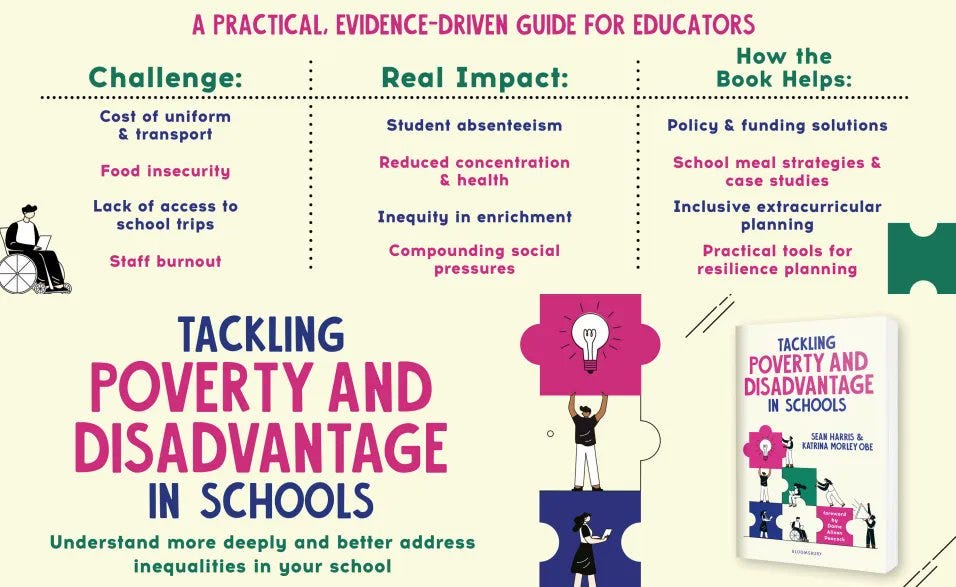
I find myself wondering whether something similar is happening in schools. The sheer density of CPD offers, initiatives, messages, and must-dos can begin to merge into a constant hum. When everything is positioned as urgent, essential, and transformational, perhaps none of it truly is. One of the strategies we share in Tackling Poverty and Disadvantage in Schools is that of ‘the eyes of an ECT’. Simply put, it means testing some of the new strategies or interventions you may introduce by asking an ECT (Early Career Teacher) what they make of it. It can help you consider whether the messaging, timescales and implementation principles are clear. I’ve found this especially useful when introducing new mechanisms around behaviour for learning in classrooms and introducing new systems to support behaviour.
This ‘background’ noise issue doesn’t just affect adults working in schools. Every new initiative carries implications for pupils; changed routines, renewed expectations, shiny pedagogies, revisited expectations of behaving and engaging. For children and young people already navigating instability, inequality, or unmet need, continual change can chip away at safety, predictability, and coherence. This can especially be the case for pupils facing poverty-related barriers to learning or SEND.
I increasingly wonder whether we underestimate how often our professional restlessness becomes children’s cognitive load. Even with thoughtful implementation plans and clear leadership, there is a risk that background noise grows far louder than we anticipate, particularly for those with the least capacity to absorb it. If you want to understand more about how poverty and income status can impact learning brains then read our book or look into Raizada et al (2008); McLaughlin et al (2014); or Noble et al (2015). Again, at some point, volume becomes interference.
So, whether you are an educator, support staff member or a leader, pause for a moment. Consider the sheer number of initiatives and strategies currently being implemented in your setting. Now picture a group of pupils for whom focus, regulation, or access to learning is already a genuine challenge.
What might actually feel most important or pressing to these pupils right now?
What messages are layered around these priorities that may be distracting, confusing, or adding unnecessary pressure?
To what extent do these pupils experience change as something that is done to them, rather than done with them?
When was the last time we checked in with these pupils to sense-make their understanding of a strategy and why it exists?
What other background noise surrounds this work that might be diluting its clarity or impact?
Sometimes, the most important work isn’t about adding something new, but about turning the volume down, so the signal can be more clearly heard. While this may not be as simple as ‘stopping’ initiatives, there is an argument to be had for ‘pausing’ before introducing another strategy or intervention. I’d argue that CPD is an important example of this. If the aim of CPD is genuinely to support staff to ‘get better’ at doing a particular thing or acting in a certain way, then less is more. Otherwise, we may find it becomes background noise at best.
Smarties have the answer

I’m no sales expert, but I’ve spent enough time in retail, charities, and organisations to be curious about how selling works and how badly it can go when ego overtakes empathy or understanding. Some of the most influential writing on this comes from Harvard Business Review. Decades ago, research into sales performance and workforce retention showed that organisations could spend millions on training and development, yet still experience persistently high turnover. The problem was not a lack of skill or effort, but a failure to properly diagnose the underlying issue. Training was repeatedly used as a technical fix for what were, in reality, structural, cultural, and human problems including workload pressure, misaligned incentives, lack of voice, and unrealistic expectations.
Researchers have consistently argued that, when organisations misunderstand the problem they are trying to solve, even well-intentioned interventions can amplify frustration rather than reduce it. This is further compounded by other ‘background noise’ problems too. For example, Pfeffer and Sutton (2006) found that organisations often ‘know’ what works but default to symbolic action (CPD projects, coaching models, frameworks) rather than addressing structural incentives, workload, pressure, or culture. Christensen, Bohmer and Kenagy (2000) found that many organisations apply the wrong solutions because they misunderstand the job that needs to be done. They found that in sales contexts, training was often used to fix what were actually role design, pressure, or unrealistic target problems.
Research appears to support the argument that effective selling requires empathy and ego-restraint. You cannot offer value if you haven’t understood need. This feels uncomfortably relevant to CPD that I have both led, designed and sometimes poorly implemented in schools. Educational inequality does not need saviours. It needs listeners and it needs people willing to say, “I don’t yet understand your context, help me learn.”
Sticking with the topic of selling and products for a moment. I still remember the old 1990s Smarties slogan ‘Only Smarties have the answer’ (Yes, I’m that young!). It worked to some extent. I remember it decades later. Which tells us something about marketing, messaging, memory, and the power of repetition. But this is exactly the trap that shiny and ‘off the shelf’ CPD can fall into. Too many programmes subtly imply that they have the answer; the blueprint, the model, or perhaps the fix. Yet, the promise is often more activity, more strategies, more interventions, more tools. Yet if most CPD doesn’t land, as the evidence highlights, we have to ask a harder question:
Are we mistaking confidence of delivery for quality of impact?
Perhaps more uncomfortably….
Who feels the ‘real’ cost when CPD doesn’t work?
Start with the problem, not the product

When I work with schools on inequality, it is slow and intentional by design. That’s only possible because I work within a multi-academy trust that values paying it forward and creates time and resource for intentional partnership. It would be far easier and slicker to produce glossy catalogues of CPD offers. Believe me, I’ve been tempted. But what we’ve learned is that the most impactful work begins with listening.
Understanding the problem leaders want to address is vital to getting under the skin of the barriers presented by inequality. This sometimes means exploring datasets setting the community context; listening to the lived experiences of pupils; hearing the constraints staff are working within. But, it also extends to understanding facilitators and the gains already being made.
Recently, working with Sandwell Academy in the Midlands reminded me of the power of this approach. It took time, conversations, preparation, shared sense-making, co-construction. What emerged wasn’t an off-the-shelf programme but something rooted in trust, honesty, and local need. That, to me, feels like what ethical CPD should look like for staff. Full credit to the leadership team for being prepared to listen carefully and gradually construct an approach to school improvement moulded around understanding and addressing educational inequality.
Right now, you might be in the process of designing or delivering a CPD or leadership development programme. You may have a clear sense of what activities will underpin this and why you think it is needed. Don’t let me discourage you from doing this. But, if you’re truly trying to serve schools and other settings then I’d encourage you to take a step back and pause. Reflect on the actual intention of what you are trying to achieve, especially if the product or service is aiming to dismantle facets of disadvantage or educational inequality. Before offering your CPD or edu-product, before selling it, branding it, packaging it, ask the following (ideally with others)
What problem(s) are we actually trying to solve?
Who has defined or ‘tested’ that problem?
What evidence suggests this approach will help here or in specific contexts?
What might this add to, and subtract from, already busy systems?
How will we know if it has made things better, not just busier?
I’d encourage you to hold this in mind, especially if you’re tempted to slide into my LinkedIn messages or my email inbox.
If you don’t yet understand our context, our challenges, or the community that we serve, what makes you think you can sell me the answer?
Let me be finish by stressing the fact that CPD matters. Educators and support staff need opportunities to learn, reflect, and develop if they are to respond to the evolving realities of classrooms, corridors, and communities. But, CPD must genuinely develop. That is rarely achieved by simply adding more activity, more frameworks, or more urgency.
Sometimes, the most fair and equitable thing we can do is resist the urge to add to the noise in busy and demanding school contexts. In already crowded systems, improvement does not always come from doing more, it comes from listening better. Listening to what schools are telling us and what teachers are experiencing. It means really listening to what pupils need, especially those pupils with less.
So next time someone tries to flog you CPD, it might be worth asking whether the most professional response isn’t to Continue Professional Development, but to Consider Pausing Doing.
Further links and references
Christensen, C.M., Bohmer, R. and Kenagy, J. (2000) ‘Will disruptive innovations cure health care?’, Harvard Business Review, 78(5), pp. 102–112.
Harris, S. and Morley, K. (2025) Tackling Poverty and Disadvantage in Schools: London: Bloomsbury Education.
Harris, S. and Mayle, S. (2024) The problem with research in real-life schools: Demystifying research in the busy school environment, Impact Journal, Chartered College of Teaching, 24 September. Available at: https://my.chartered.college/impact_article/the-problem-with-research-in-real-life-schools-demystifying-research-in-the-busy-school-environment/
Lichtenstein, S. and Fischhoff, B. (1977) ‘Do those who know more also know more about how much they know?’, Organizational Behavior and Human Performance, 20(2), pp. 159–183.
McLaughlin, K.A., Sheridan, M.A. and Lambert, H.K. (2014) ‘Childhood adversity and neural development: deprivation and threat as distinct dimensions of early experience’, Neuroscience & Biobehavioral Reviews, 47, pp. 578–591.
Noble, K.G. et al (2015) ‘Family income, parental education and brain structure in children and adolescents’, Nature Neuroscience, 18(5), pp. 773–778.
Pfeffer, J. and Sutton, R.I. (2000) The Knowing–Doing Gap: How Smart Companies Turn Knowledge into Action. Boston, MA: Harvard Business School Press.
Pfeffer, J. and Sutton, R.I. (2006) ‘Evidence-based management’, Harvard Business Review, 84(1), pp. 62–74.
Raizada, R.D.S., Richards, T.L., Meltzoff, A. and Kuhl, P.K. (2008) ‘Socioeconomic status predicts hemispheric specialisation of the left inferior frontal gyrus in young children’, NeuroImage, 40(3), pp. 1392–1401.
Teacher Development Trust (2025) Teacher Development: The CPD Landscape in 2025. London: Teacher Development Trust.
Walton, G.M. and Cohen, G.L. (2011) ‘A brief social-belonging intervention improves academic and health outcomes of minority students’, Science, 331(6023), pp. 1447–1451.
Wagmiller, R.L. (2015) ‘The temporal dynamics of childhood economic deprivation and children’s achievement’, Child Development Perspectives, 9(2), pp. 79–85.
Really thought provoking. As a freelancer trying to work alongside schools to develop bespoke strategies to support inclusion for GRT it is impossible to compete with the brochures. They represent something big, generic and fomo-driven, whereas my emerging work is quiet and minority focussed. It’s almost impossible to be of service to marginalised groups within schools via adaptive, internally developed CPD when schools are forced to ‘keep the main thing the main thing’. I appreciate this comment looks terribly vicarious, even resentful. My point is that big, bright ideas win over quiet, impactful and targeted empowerment for minority groups via the investment of schools in both systems and staff confidence.
Another amazingly well researched piece, with fascinating thinking points and great suggestions to make the most of our CPD in Trusts and Schools.