
'Lean into' knowing
If you can't stand the heat in the kitchen, consider getting closer

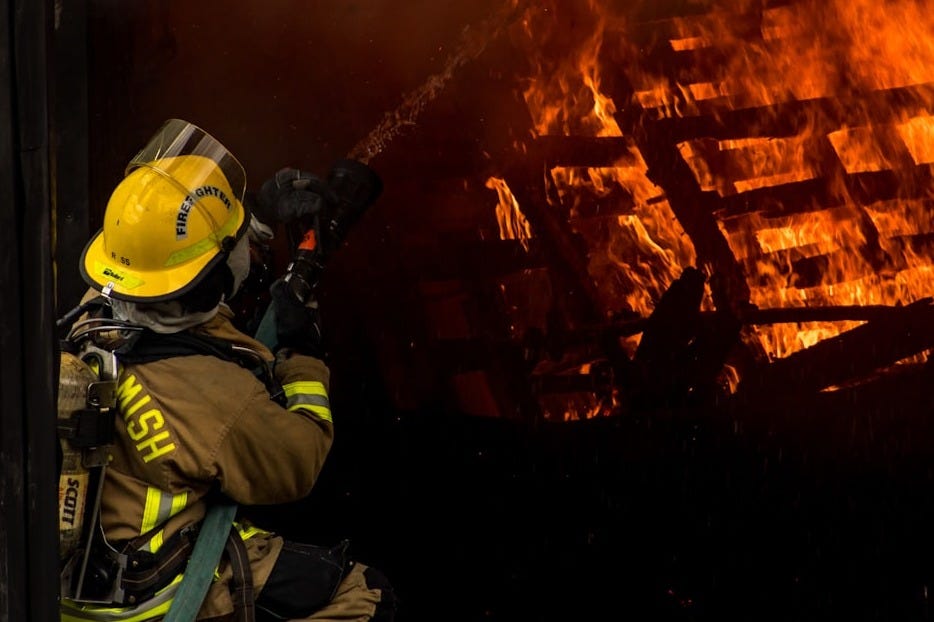
I’m told that firefighters are trained to do something that feels counter-intuitive for many of us. When your whole body is pushing to pull back, the discipline is to do the opposite, to gradually approach the heat, understand and read it. This isn’t my attempt to promote safety training or firefighter blog tips; it’s rooted in what the science of fire tells us about how danger behaves. I also think it may give us some clues as to how we get better at understanding and tackling inequality.
I’m keen to also know how others are leaning into better understanding inequality and complex issues such as poverty. So, by all means share your insights. Especially important if you’re working in environments that are particularly complex and challenging at times.
A fiery recap

A quick science-revision guide style recap, just in case you need it. Heat and superheated gases can travel well ahead of visible flames, shaping conditions long before somebody can actually see the fire they are dealing with (Madrzykowski & Kerber, 2009; UL Fire Safety Research Institute, 2014). I know, I know… most primary teachers, science specialists, and lab-based educators reading this will be gently rolling their eyes as I remind myself of the basics. But here’s a further element of this science perhaps lesser known by my usual readers. Modern firefighting training and doctrine increasingly treat fire dynamics, airflow, and heat gradients as data, not just something to be cautious about. The fire is constantly communicating what it is likely to do next, if you know how to read the cues (NIST, 2026). In practice, this is why firefighters often advance low, beneath the hottest layer, continually taking the temperature of the heated space, noticing the movement of air, sensing the feel of the environment, and letting that intelligence shape the decisions that are made.
Don’t worry, you’ve not accidentally hit subscribe on That Firefighting Guy (though there probably is a Substack for it). I’m sharing this because it sits well alongside some research tells us about situational awareness and expert decision-making in high-risk, and complex organisational settings. The pattern across this literature appears to remind us that effective action depends on noticing what matters, making sense of it, and anticipating what might happen next, rather than reacting once the moment has already passed or become embedded (Endsley, 1995; Klein, 1999). It’s reminding me that one rarely deal well with a heat source that they refuse to understand at close range, and distance can have a habit of turning complexity into assumption.
Before going any further, let me offer a couple of caveats. First, I’m not experienced in firefighting thank goodness. I applaud those that are and that understand this way more than I’ll ever have to. More importantly, in using this metaphor, I am not suggesting that children or families facing hardship are themselves a problem to be extinguished. Instead, I’m aiming to remind us that inequality is a fierce problem, not the people living with or within it. Like fire, the flames of inequality are fanned by multiple, interwoven sources, policy decisions, stigma and limited access to support, and persistent trends of poverty.
Social research can help to name what happens when we get too comfortable keeping our distance, because stigma does not operate as an individual flaw or a personal deficit, it functions as a social process that labels, segregates, diminishes, and often leaves people carrying shame, withdrawal, and misrecognition on top of the material and fiscal weight of poverty itself (Goffman, 1963; Link and Phelan, 2001; Chase and Walker, 2013). In education, I believe that this is sometimes how we end up treating absence, disengagement, behaviour or attainment gaps as ‘problems’, when they may be better understood as heat and other elements travelling above surface of a deeper source. If we step back from that heat because it’s uncomfortable, politicised, or complex, we can sometimes lose the very insights or data needed to make sense of what is really burning underneath or adding fuel to the firefight.
Staying in the kitchen
The saying “if you can’t stand the heat, get out of the kitchen” probably carries some truth. However, my main heat with the phrase is a practical one… the only time I’m usually in a kitchen is when I’m cooking for my family, and getting out of it isn’t an option. A hungry family rarely makes for a calm or harmonious household! My second issue is one you may be able to better relate to. For some, the phrase quietly reinforces an idea that the simpler, less complex route is a better solution. Yet in the real world, in high-challenge environments like schools, charities, community centres, and services working alongside those facing poverty, walking away is not something many of us can seriously consider. That said, there are moments when the physical and psychological strain of working so close to complexity makes stepping back necessary. I’ll touch on this at the every end.
There is solid research evidence to show that across sectors, high stress, burnout, and fatigue are consistently linked to people stepping back from demanding professions, often early in their careers. Work-related stress fuels burnout, which in turn strongly predicts turnover intention, the cognitive and emotional process of thinking about leaving a role, and frequently precedes exiting roles (Schaufeli and Bakker, 2004; Salvagioni et al 2017). I want to stress that burnout is not simply about being ‘tired’. It is associated with emotional exhaustion, reduced professional efficacy, and disengagement, all of which increase the likelihood of withdrawal behaviours such as stepping away, reducing commitment, or leaving entire sectors (Maslach, Schaufeli and Leiter, 2001). Some research also highlights that job complexity itself matters. When work is highly demanding, emotionally charged, and difficult to make sense of, people are more likely to psychologically distance themselves as a coping strategy, particularly where clarity, support, or organisational coherence is limited (Van der Heijden et al, 2023). In roles characterised by high emotional labour and moral responsibility, including health, education, and care, the mental health strain associated with burnout has been identified as a pathway linking complexity and workload to intentions to leave (Dall’Ora et al, 2020). In that sense, stepping back is not a failure of resilience, but often a rational or logical response to sustained overload and complexity. We are only human after all, no matter how much you’re relying on those AI prompts to help your workload.
In recent years, I’ve worked alongside colleagues across multiple sectors such as health, education, arts, and industry/business to better understand poverty and inequality. One question I’m routinely asked is where individuals and teams can start if they want to understand what inequality looks like in their immediate communities. I find this question hopeful, because it signals a desire to move closer to complexity rather than away from it. I’m motivated by people want to get closer to the data in the kitchen, and to the heat sources that might tell us what is really happening.
In schools and education settings, for example, many leaders recognise that Free School Meal eligibility or Pupil Premium data rarely provides a full or nuanced picture of disadvantage within a community (Gorard & Siddiqui, 2025) That doesn’t mean these datasets are wholly unhelpful, but relying on them in isolation risks oversimplifying something that is anything but simple. Used alongside other sources, they can become far more meaningful and useful.
This isn’t an exhaustive list, but some ready-to-use links I often recommend:
Annual analysis from the End Child Poverty Coalition, produced with Loughborough University, offers constituency and local authority-level insight into household income and child poverty trends. You can readily download datasets to find out levels of child poverty in your local area.
The Joseph Rowntree Foundation’s annual UK Poverty reports provide accessible analysis of national hardship trends and some of the geographical disparities that exist for different regions and groups in society too.
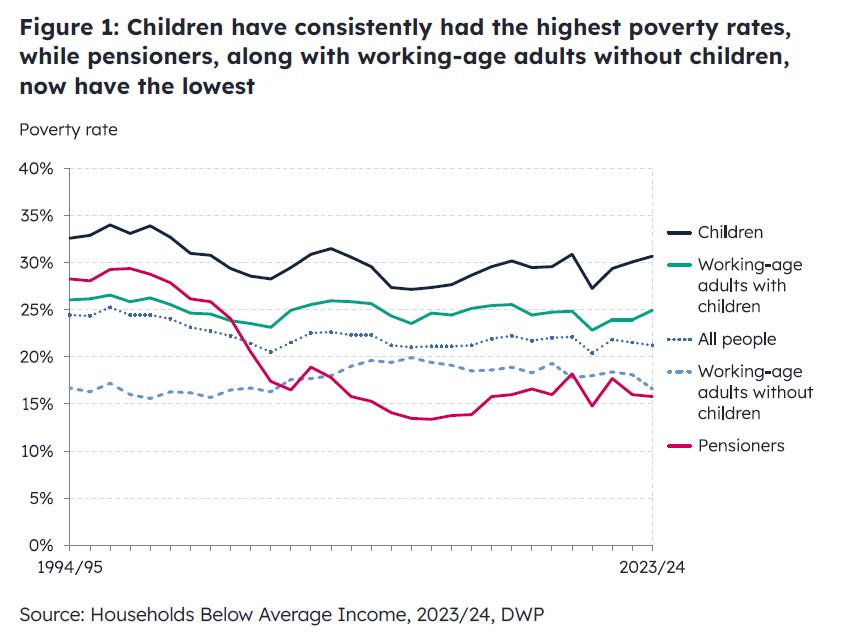
(Source: JRF, 2026)
Regionally, organisations such as the North East Child Poverty Commission deepen this picture by calling out place-based barriers and structural conditions shaping inequality. You may have other regional links such as this.
The Sutton Trust adds further texture through an intersectional lens on social mobility. In this data, they provide a detailed look at the geography of opportunity and social mobility in England. They examine how socioeconomic background, geography and opportunity interact, with data looking at both parliamentary constituency and regional level.
Organisations such as Trussell provide vital insight into food insecurity through data on foodbank distribution and demand. Useful if you’re trying to understand what hunger looks like in your area. Search your postcode here.
This is not an exhaustive list. But taken together with other intel, these sources can help us to identify possible pain-points and the heat within the places in which we are working and serving. I continue to argue that taking the time to understand and routinely map these conditions is essential before we rush to design solutions or start conjuring up new recipes for addressing need. Without that understanding, there is a risk of constantly firefighting or misunderstanding what the flames of inequality might be telling us in the very kitchens, or communities, that we are trying to serve in.
Tasting and seeing

Let me cook for you sometime. I’ll be upfront, you’ll get a different experience every time (not always a good one!!) While I’m more than happy in my working life to follow careful implementation plans, colourful Gantt charts, and well-structured evaluation reports, I’m far less forensic when it comes to my culinary life. There is something fun cooking by sensing the process as I go. Tasting, adjusting, noticing what might be happening in the moment, rather than rigidly following a set of instructions and hoping the end result tells you everything you need to know. That said, my tiramisu does come with a small warning label… a non-trivial chance you won’t be legally driving anywhere afterwards! I favour flavour over measurements…
Back in the kitchens and alongside the fires we are serving in, I believe that some of same principle holds. Even when projects or interventions are ‘baked’, there is something necessary about continually sensing what is happening as the work unfolds. Relying solely on mid-point or end-point evaluations assumes that learning only happens at fixed moments, when in reality the most useful signals often show up in between. This is where an over-reliance on any single source of data becomes problematic. Numerical, quantitative data matters, but on its own it offers only a partial view of poverty. I’m not suggesting we take it with a pinch of salt so much as recognise its limits; numbers can tell us what is happening, but they rarely tell us how it feels, why it’s happening, or what it’s like to live within it.
There is something important and compassionate about getting close enough to sense the lived reality of inequality in the communities we serve. To be clear, this is not a call for a ‘poverty-porn’ style spectacle or the public consumption of hardship. Like many school leaders, I’ve been guilty some years ago of what I now think of as the misplaced ‘poverty safari’ induction tours, loading early career teachers onto a minibus and driving them around the local estate to provide a crude context of the community. Context matters, but I’ve increasingly questioned how much stereotyping, distance, and unintended harm these moments can create if they are not handled with deep care, humility, and respect for the very communities that we exist to serve.
Instead, I’m arguing for something quieter and more relational. Talking with people, not about them. We don’t all need to complete a PhD in poverty to do this well, and in fact, I’m increasingly convinced that some of the most compassionate learning happens when research doesn’t feel intentionally academic at all. I’ve written elsewhere about how schools, in particular, can work using co-production principles with children and young people to better understand inequalities and barriers to learning, positioning them not as subjects of research but as partners in sense-making lived realities. Communities cannot simply be a subject to be studied.
In practice, this might look like:
Routine, well-facilitated focus groups with families, creating safe spaces to talk honestly about the local area and everyday pressures.
Opportunities for families and children to talk about inequality more broadly, not only to speak when they themselves are in need.
Anonymous surveys or feedback tools, allowing people to name emerging issues without fear of judgement or consequence.
Community organising approaches, such as those modelled by Citizens UK, which work with residents to identify priorities and act collectively, rather than doing things to or for communities.
We share further practical examples of how this can be done well in Tackling Poverty & Disadvantage in Schools, drawing on schools and partners who have learned, sometimes the hard way, that the best insights rarely come in the form of one-off recipe for social research or intervention. They come from being in the kitchen alongside others, next to heat sources, sensing the solution as it changes and being willing to adjust before things burn badly.
Shouldering heat

One of the most important practices in firefighting rarely features in the heroic imagery we tend to see. As firefighters advance through smoke and heat, they often keep a hand or forearm on the person in front of them. I first noticed this when supporting a group of young people on work experience with a local fire service. It the most collaborative I had ever seen this particular group of young people work together! But it wasn’t symbolic theatre or team-building for show, it was a tactical necessity, grounded in human factors and good teamwork science.
In environments defined by zero visibility and rapid, unpredictable change, physical contact can help maintain shared orientation and situational awareness, reducing the risk of disorientation, separation, or even panic (Salas, Sims and Burke, 2005; Klein, 1999). Research on high-risk teams consistently shows that effective coordination in ambiguous, and heated, environments depends on shared mental models, mutual support, and cohesive communication. No individual, no matter how skilled, operates effectively alone in these conditions; progress and safety are collective essentials (Salas et al, 2005).
I believe that these principle matters far beyond firefighting, and I think it is vital when we talk about tackling inequality. Emergency responses work largely because they are ecosystem-based. Firefighters, paramedics, police, control rooms, and community responders each bring different perspectives and domain-specific expertise, relying on interoperable communication and mutual support to function effectively (Wankhade, 2019). In the event of a town-wide terror incident or a major disaster, no single service exists to ‘solve’ the emergency alone. Increasingly, I believe our response to inequality needs to operate in much the same way. Poverty, inequality and barriers to learning are not issues that schools, charities, health services, or local authorities can address in isolation, no matter how committed or capable they are. Meaningful understanding and response requires shared visibility, shared intelligence, and shared responsibility across local ecosystems. We might describe this as a collective, or ‘place-based’ partnership, orientation to data, living experiences, resources, and action.
When we place a hand on the shoulder of those working alongside us, across sectors and communities, we are far more likely to be better oriented, avoid fragmentation, and move towards something informed and more just for the people we serve. This is not an exhaustive list, but here are a few real-world questions to help surface whether we are truly putting a hand on shoulders alongside us:
You identify a funding pot to tackle a local dimension of inequality. To what extent do you submit a bid as a single organisation, or work with others to strengthen the proposal and resource around a collective response?
You decide to run an event to raise awareness of local poverty and inequality. To what extent do you plan it first and then invite others in, or instead take initial ideas to local partners and ask them to help design it with you?
You are invited to speak on a panel or deliver a keynote. To what extent do you showcase the wins and polished outcomes, and to what extent do you share the messier, more uncomfortable learning, modelling the humility needed to remain curious with others about what does/does not work?
I’m not suggesting that I always get this right. What I am arguing for is a deliberate act of reaching a hand out to those in front of us, and perhaps steadying the efforts of others behind us too. I want to do this with an honest recognition that we are only ever one part of the solution. Our recent PLACE: The Story So Far report at Tees Valley Education reflects our mental model that serving communities is not only about achieving strong educational outcomes, but about working with others to better understand, get closer to, serve, and learn from the communities and partners. That is why we felt it mattered to capture this learning and share it.
A quick fire safety announcement…
I am advocating for us to be ‘furiously curious’ in the pursuit of understanding and responding to local need, rather than retreating to distance, assumption, or overly simple ideas presented by data. But leaning in does not mean putting ourselves in the way of harm or pretending we can carry this work alone. Just as firefighters never enter a burning building without expertise, equipment, and a team of well-trained colleagues around them, our work on inequality must be done with care for our own safety and wellbeing too. Please do not feel you have to firefight without support, expertise, or an ecosystem of partners alongside you. The work is too complex, the heat too intense, and the stakes too high for anyone to do this in isolation.
If you can’t stand the heat in the kitchen, get closer to it and better understand it. Just make sure you’re doing so alongside others, grounded in partnership rather than heroic ego. Otherwise, we risk burning ourselves out or unintentionally causing harm to the very people we hope to stand with.
References and further links
Chase, E. and Walker, R. (2013) ‘The co-construction of shame in the context of poverty: Beyond a threat to the social bond’
Dall’Ora, C., Ball, J., Reinius, M. and Griffiths, P. (2020) ‘Burnout in nursing: A theoretical review’, Human Resources for Health.
Endsley, M.R. (1995) ‘Toward a theory of situation awareness in dynamic systems’, Human Factors, 37(1).
Goffman, E. (1963) Stigma: Notes on the Management of Spoiled Identity. Englewood Cliffs, NJ: Prentice-Hall.
Gorard, S. and Siddiqui, N. (2025) How useful is household income as a factor in explaining attainment at school in England? Assessing the Parent Pupil Matched Data (PPMD). Durham: Durham University Evidence Centre for Education.
Harris (2026) ‘Student voice: School–research partnerships’, SedEd. Available at: https://www.sec-ed.co.uk/content/best-practice/student-voice-school-research-partnerships
Harris, S. and Morley, K. (2024) Tackling Poverty and Disadvantage in Schools. London: Bloomsbury Education.
Joseph Rowntree Foundation (2026) UK Poverty 2026: The essential guide. York: Joseph Rowntree Foundation.
Klein, G. (1999) Sources of Power: How People Make Decisions. Cambridge, MA: MIT Press.
Link, B.G. and Phelan, J.C. (2001) ‘Conceptualizing stigma’, Annual Review of Sociology, 27, pp. 363–385.
Madrzykowski, D. and Kerber, S. (2009) Firefighting tactics under wind-driven conditions. NIST Technical Note 1618. Gaithersburg, MD: National Institute of Standards and Technology.
Maslach, C., Schaufeli, W.B. and Leiter, M.P. (2001) ‘Job burnout’, Annual Review of Psychology, 52.
National Institute of Standards and Technology (NIST) (2026) Fire.gov: Fire dynamics and fireground decision making (SLICE-RS). Gaithersburg, MD: NIST.
Salas, E., Sims, D.E. and Burke, C.S. (2005) ‘Is there a “Big Five” in teamwork?’, Small Group Research, 36(5), pp. 555–599.
Salvagioni, D.A.J., Melanda, F.N., Mesas, A.E., González, A.D., Gabani, F.L. and Andrade, S.M. (2017) ‘Physical, psychological and occupational consequences of job burnout: A systematic review of prospective studies’,
Sutton Trust (2024) Double Disadvantage: How SEND and poverty intersect. London: The Sutton Trust.
Trussell (2025) Hunger in the UK: Food bank use and food insecurity data.
UL Fire Safety Research Institute (2014) Study of the impact of fire attack utilizing interior and exterior streams on firefighter safety and occupant survivability. Northbrook.
Van der Heijden, B.I.J.M., Peeters, M.C.W., Le Blanc, P.M. and Van Breukelen, J.W.M. (2023) ‘The moderating effect of burnout in the relationship between job complexity and psychological detachment’, Journal of Occupational Health Psychology, 28(2).
Wankhade, P. (2019) ‘Understanding coordination in emergency response systems’, Journal of Contingencies and Crisis Management, 27(2), pp. 168–176.