

Hello, goodbye...
Why place matters more than rock star school leaders and pop-services


There is something deeply humbling about working in places that existed long before us and that will remain long after we are gone. One of the privileges of my role as a ‘Director of PLACE’ is that it allows me to spend time in schools and communities across the UK, listening to educators, leaders, families and young people trying to navigate complex realities with dignity.
At Tees Valley Education, we were intentional when we designed this aspect of our work with others. In practical terms, it helps to sustain and resource the approach within a multi-academy trust. More importantly, it means we can be deliberate about where we work, who we work alongside and the kinds of conversations we want to have. It allows us to remain curious about inequality beyond the immediate communities or places that we serve in the North East of England.
Despite the long drives, train journeys and countless miles away from basecamp, the work fills our cup. Not because we arrive carrying answers and insights, but because we encounter people and organisations doing genuinely meaningful work in the places that they serve. Across education, community organisations, health settings, charities and civic partnerships, there are countless individuals choosing to persist on behalf of others, especially those people with less.
Many of these people and organisations would never describe themselves as pioneers. In fact, most actively resist labels like this. Perhaps that is partly because it feels terribly ‘un-British’ to see oneself in such terms. But, perhaps it also reflects an understanding and realisation that none of us are truly starting from scratch when it comes to understanding and tackling deep-seated inequalities.
“The Long and Winding Road”

Recently, I travelled to Liverpool to spend time with colleagues at the Academy of St Nicholas, part of All Saints Multi Academy Trust. A long and winding road from the Tees, but one which was well worth it.
Liverpool has always felt familiar to me. Much of my family were ‘Scousers’ and some of my happier childhood memories involve weekends spent wandering through Merseyside with my grandparents, hearing stories about streets, docks, buildings and places that mattered to them. Long before I understood concepts like ‘place-based’ working or civic identity, I was learning that places carry memory and meaning. The familiar sound of Scouse accents clearly helped.
The work with the Academy of St Nicholas had been carefully co-constructed over some months. As with all of our poverty-informed practice work, we try to avoid simply arriving and delivering a generic training resource. We spend time understanding context and we speak with staff and listen to pupils. All with the intention of looking deeper than surface-level datasets and attempting to understand the narratives that exist beneath them. This helps to get a sense of the ‘place’ you are in and serving alongside.
What resonated with me quickly was the dignity with which leaders spoke about challenges. There was no performative despair and no reduction of children or communities into mere statistics. Instead, there genuine honesty, compassion and curiosity. Of course, data matters and we explored government datasets alongside insights from organisations such as the Joseph Rowntree Foundation, UCAS and The Sutton Trust to better understand national and local context alongside patterns of inequality. But leaders were curious in what data could not immediately tell them. They wanted to understand the living realities behind categories such as FSM (free school meals) or pupil premium, rather than allowing those labels to become the sum total of a student’s identity or a specific approach from leaders.
As part of our work with teachers and support staff, we explored local ‘pioneers’ and places connected to struggles for social justice, belonging and societal change. Not because schools need heroic narratives, but because communities often already contain some of the stories we need to help us think differently about the present ‘place based’ issues that we are seeking to understand and tackle.
Taking each of the Academy values, we briefly looked at some of these places and people that have helped to navigate the places we now serve.
On Compassion, we discussed Abdullah Quilliam, born William Henry Quilliam, who established Britain’s first mosque and Islamic centre in Liverpool. More than simply a place of worship, it became a place of hospitality, learning and belonging. Compassion, we reflected, has often been about creating spaces where people feel seen and welcomed.
For Resilience, we explored St Anne’s Church in Aigburth. The church itself bears traces of suffragette direct action in 1913, standing as a reminder that many social advances emerged because people were willing to persist despite criticism and resistance. Yet, resilience was also found in quieter stories. In January 2025, Pam Knowles achieved a Guinness World Record for becoming the world’s longest-serving Sunday School teacher after more than 73 years of service at St Anne’s. The extraordinary and the ordinary existing side by side!
With Ambition, we discussed the work of the Anthony Walker Foundation and the legacy of Gee Walker. Following the racially motivated murder of Anthony Walker in 2005, his family chose not to allow his death to become another forgotten statistic. Instead, they established a foundation dedicated to tackling racism, hate crime and discrimination through education, advocacy and support. Ambition here was not about status or prestige but about refusing to let injustice have the final word in these local and national communities.
Reflecting on Respect, we discussed the nearby International Slavery Museum. Liverpool could have attempted to hide or subtly ignore from difficult parts of its history. Instead, the city chooses to intentionally create places and spaces that encourage reflection and dialogue.
I am not suggesting that these people or places are the only or best-fit examples. For some, they may even be problematic. But they do carry some weight in this place because they remind us that none of the challenges schools face today exist in isolation from history, place or community. Yet too often within education and other sectors, I hear talk about ‘our’ strategies, initiatives and interventions as though they are entirely new.
Perhaps we may, at times, even describe ourselves as ‘innovative’ or ‘pioneering’ while perhaps forgetting or ignoring the countless people who have spent generations attempting to challenge inequality before us. Even the word pioneer can become problematic if it encourages us to believe we are the first or the most crucial to care.
“We can work it out”

At Tees Valley Education, we often speak instead about being civil and social architects rather than innovators. That language can be useful because architecture can imply stewardship rather than ownership. It acknowledges that we are helping to shape environments, craft relationships and opportunities but doing so alongside many others (past and present). It also reminds us that our role is not simply to improve educational outcomes, of course these are important but what we want is outcomes for communities that we serve beyond the headline measures of an academic year.
I have written before about the dangers of possessive language in education and on the topic of ‘place based’. The idea of ‘our’ community or ‘our’ schools can become complicated. Places are not things that we own, they are ecosystems that we navigate together. It’s fine to use the word ‘our’, as long as you really mean it is shared with others and this is understood by others. Places existed before any current strategy, leader or institution and they will continue to evolve afterwards. It is also why I find it deeply uncomfortable when new leaders arrive in a setting and speak of everything they are introducing as though nothing of value existed before them. I have been guilty of this myself. Of course, leadership often involves addressing mistakes, tensions, or practices that needed to change, but dignity in places is important. Sometimes what we frame as repair in places is often our own interpretation of improvement through a particular lens, shaped by the priorities and trends of our time, before the next chapter of the journey inevitably begins after us.
I increasingly question how much any of us can truly understand about a place from a distance. Inspection frameworks, public datasets and headline outcomes undoubtedly provide important insight. They may even offer a degree of objectivity prior to visiting a place. But they can never fully capture the texture or architecture of a place. You only begin to understand that when you spend time within it, listening to young people, observing relationships, noticing routines and hearing the stories communities tell about themselves and of the places that they navigate.
One example that stayed with me from the Academy of St Nicholas came from the Art department, led by another Shaun (artist and educator Shaun Smyth), the curriculum leader for Art and Design. Students had undertaken an ambitious project exploring place, identity and culture through art. Their work began with investigations into Liverpool and the wider North West, its coastline, industrial heritage, architecture and green spaces. Through photography, drawing and mixed media, students explore how artists capture atmosphere and identity. Take a look at this sketch drawn by a student in the Academy on an OS map…
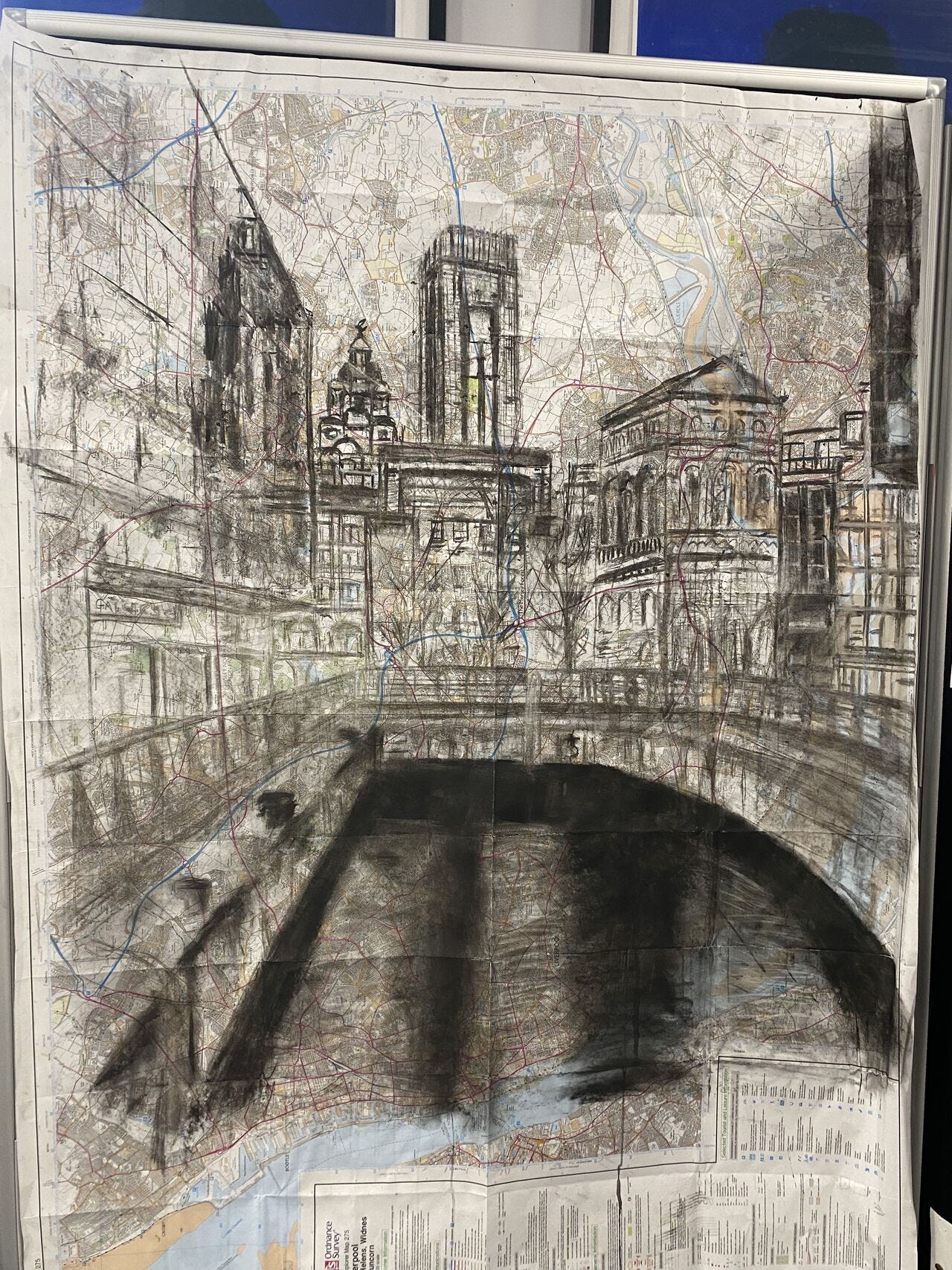
(Source: Student work, Academy of St Nicholas)
Shaun writes,
As the work continues to develop, the focus has expanded to include architectural styles from around the world, inspired by the diverse cultural backgrounds represented within the school community. Students researched buildings, patterns, and structural forms from a variety of countries and traditions, comparing global design approaches with those found locally. This shift allowed students to celebrate their own heritage while developing a broader understanding of international artistic influences.
The work produced has been ambitious in both scale and media, with students experimenting confidently across drawing, painting, collage, printmaking, and large‑format mixed‑media pieces. Many students pushed themselves to work on larger surfaces and more complex compositions than in previous years, demonstrating growing independence and creative maturity.
The project has expanded to include architectural styles and artistic influences from around the world, inspired by the cultural diversity within the school community itself. Students compare global traditions with local landscapes, celebrating both heritage and belonging. The resulting work is thoughtful and technically ambitious, culminating in entries to national competitions and an exhibition opportunity at the Walker Art Gallery.
What stood out to me here was not simply the quality of the artwork (but that did make me go wow!). It was that students were being invited to see themselves as part of something larger; connected to place, history, culture and opportunity. As mentioned by Shaun and students, the artwork created has encouraged students to think critically about place, identity, and culture. It also presents a body of work that reflects both their local surroundings and their global perspectives.
“A Day in the Life”

Another strand of work we explored with staff was the idea of ‘diet walks’. It is a concept that we talk about in the award-winning book Tackling Poverty and Disadvantage in Schools and something we have supported many settings with.
The process involves examining participation and belonging in the school day through the lens of pupils experiencing poverty-related barriers to learning. Ideally, this work is done alongside young people themselves, shadowing their experiences directly. But there is also value in asking adults to predict what a school day might feel like for those facing disadvantage and then comparing those assumptions against reality. Reach out directly if you need more indicators of what this involves.
What stood out to me at the Academy of St Nicholas was the intentionality around preparation for learning. Through routines, touch points with key adults and practical support, the Academy has created systems that normalise readiness and reduced unnecessary friction for students. Interestingly, young people told me about about this themselves and confidently can share about how the Academy supports them as part of passing conversations with visitors (it isn’t rehearsed and it does not need to be!). Equipment and resources are available, expectations are clear, support is visible without being stigmatising. None of this was presented as extraordinary or innovative, but rather as part of the ordinary architecture of the school day.
Watch this welcome video from the Academy that is used to support new students with transition to get a sense of how this looks in practice.

(Source: Academy of St Nicholas, 2026)
“Let it be”

Maybe we are making phrases like place-based and belonging too complicated…
‘Place based’ is sometimes discussed in abstract terms or it is used without a definition of what is meant by it. Like poverty itself, the language can become so broad that it loses reference. But I am learning that place is ultimately about people, relationships, routines, histories and environments. It is about whether children and young people, especially those with less, feel seen within the spaces they move through every day. I would extend aspects of this to the buzz of ‘belonging’ that we hear around education spaces and policy discussions at present also.
At a time when many of us rightly champion place-based approaches, I think we must remain careful and cautious of topical terminology, especially that associated with policy, funding and inspection frameworks. Place is not ours to claim ownership over. We are participants within place, not proprietors of it. I say that with an awareness of my title as Director of PLACE! (But do look up our definition if it helps!).
Whilst we absolutely have an important role to play, the challenge is ensuring that the places we help shape are capable of lasting beyond any individual leader, intervention or organisation. Schools matter enormously, but they are only one component part of a wider social and civic-ecosystem consisting of families, community organisations, faith groups, local histories, public spaces and the countless people who hold communities together in ways that rarely make headlines or glossy reports.
If phrases like place-based or belonging belong to anyone, perhaps they belong most to those who have historically been least heard within spaces. Those who perhaps struggle to belong because they don’t feel that they matter. The challenge for all of us is not simply to deliver programmes or implement strategies, but to remain ‘furiously curious’ about the places we serve and navigate. To recognise that others have come before us carrying the same hopes for justice, dignity and opportunity; we belong to something bigger than any of us and any of our ambitious policies, strategies, projects or innovations.
The Academy of St Nicholas would not claim to have solved inequality, nor would its staff present themselves as pioneers or innovators with all of the answers. What they are doing, however, is asking important questions about what it means to act as civic and social architects within a community. Not their community, but the community they serve alongside others.
I want to continue serving places with the humility to recognise that whilst we may contribute to them for a season, the place itself, its people, histories, relationships and future, matters far more than us or any individual project, strategy or intervention we bring into it. Perhaps that is something all of us working in social and civic spaces need reminding of from time to time.
Thank you Liverpool, ‘you really got a hold on me’ (to quote another Beatles number!)
Thank you to the staff and young people at the Academy of St Nicholas for your honesty, curiosity and generosity. One colleague kindly described the training together as “boss”, a word Scousers use with such effortless affection and sincerity that it somehow carries far more meaning than simply saying something landed well. I’ll take that back into the places I serve.
Things to be curious about in the places you exist
I have noted the following as things to be curious about rather than as pointed questions. You may find them useful to discuss with others/teams.
How well do we truly understand the lived realities of the communities you serve beyond the datasets you routinely use?
Which local stories, people, histories or places shape the identity of the school or organisation, and whose stories remain unheard?
In what ways does our language unintentionally position us as ‘owners’ of place rather than contributors within it? (worth a look at your website!)
If somebody unfamiliar with our setting spent a day here, what would they notice about belonging, dignity and care in the places we navigate?
To what extent are our strategies and interventions designed to survive beyond individual staff members, leaders or funding cycles?
Who were the civic and social architects that came before us locally, and what can we learn from their persistence, mistakes, setbacks and courage?
Where are the touch points throughout the school day that communicate to children “You belong here, and we have prepared this place with you in mind”?
If our strategy disappeared tomorrow, what relationships, routines, cultures and partnerships would remain strong enough to continue supporting children and communities well in the places we serve?
A really lovely, heartfelt and informative post about how you approach your work Sean, keep up the good work!!