

Have I still got your attention? (Part 2)
It's the end of an academic year, but don't let that distract you....


If you read Part 1 and returned for this, then it means I’ve got your attention. Thanks! Last week, I explored why attention deserves more attention in conversations about poverty, inequality and learning.
For some children and young people, attention may already be stretched by stress, hunger, poor sleep, shame or uncertainty before learning even begins. I explored how we should avoid making crude assumptions or lower expectations. Instead, I argued for the need to ask better questions.
Attention is something worthy of our attention. It is the difference between noticing something and not noticing it; a good split decision and a poorly executed one. Part 2 explores further implications for practice… probably worth more of our attention
Many educators will be familiar with the famous ‘invisible gorilla’ experiment by Simons and Chabris (1999). Participants were asked to watch a video and count basketball passes. While concentrating on the task, a person in a gorilla suit walked through the scene. Remarkably, the vast majority of participants did not notice the gorilla at all. The study became one of the best-known demonstrations of inattentional blindness; when our attention is intentionally focused elsewhere, most of us can miss something obvious right in front of us. I’ve ruined the ending now, but if you want to see it play out check out this video.
I have been giving this attention recently and its implications for those of us working in areas of high need. Rightly so, our focus is often on the impact of poverty and inequality on the children and families it hurts the most. That must remain central, but I wonder whether there is another gorilla in the mist. The experience of serving in high-pressure, high-need environments may also be shaping the attention, judgement and cognitive bandwidth of those working and serving within them.
Gorillas in our mist

Let me give a personal example. In one of my various leadership roles some years ago, I worked in an area of high challenge. Resources were tight, budgets were limited and need was rapidly increasing in the community. It was a role I enjoyed, for the most part. The staff were brilliant; pupils were wonderful. Yet, like all schools filled with human beings, there were mistakes, difficulties and moments that hurt. I ended up working around the clock. Evenings, early mornings and weekends all became part of the routine, and the problem was that it still did not seem to shift the levels of high need seen in almost every area of the community. Every day became a fire fight; there was always another issue, another urgent need, another problem to solve, another plate to keep spinning. I am sure there were things we could have done differently even then, but we didn’t seem to have the capacity to do anything about this.
Eventually, I left the role for pastures new. I did not leave under a cloud and in many ways, I still look back on the role with appreciation. But in the months and years that followed, I noticed something. I could think more clearly, I could focus better; sense-check decisions more sharply. My interactions with friends, colleagues and, above all, family seemed to be generally healthier too. Yet I hadn’t spotted the gorilla amidst the daily fog or mist that I had been working in.
This is worth your attention if you care about your efforts to make a difference.
Looking back, I now think I had normalised a stress response. I had normalised the aches and pains at the end of the week; standardised walking into school wondering what would go wrong that day and how long it would be before an ‘urgent’ issue was brought to me. I had normalised the growing sense of dread as results days approached too. I knew aspects of the improvement model were not working, but amidst the mist of urgency and gorilla workload, I did not have the attention to give that realisation the attention it needed. Perhaps others and I did not have the cognitive bandwidth to fully appreciate what was happening because we did not really understand the barriers or the problem.
Evidence is perhaps worth further attention here again also. Lupien et al (2009) reviewed evidence on the effects of stress across the lifespan and showed how stress can affect the brain, behaviour and cognition. Chronic stress is not just an emotional inconvenience; it can shape attention, memory, decision-making and how people respond to threat or uncertainty.
This is worth your attention if you care about your efforts to make a difference.
This feels especially important in education and charities because improvement work often assumes that we can keep adding more; more interventions, more monitoring, more data, more meetings, more urgent actions, more “quick wins”, more strategies, more everything. Yet cognitive load theory reminds us that working memory is limited and that learning can be hindered when unnecessary load overwhelms the capacity to process what matters (Sweller, 1988). This is usually applied to pupils in classrooms or students in university, but I think it has something useful to say about adults too. If leaders and educators are overloaded, distracted and constantly switching between urgent demands, then we should not be surprised when deep thinking becomes harder. Yet deep learning is something that we often need.
This is worth your attention if you care about your efforts to make a difference.
I wonder how many others are in this position. Some may still be in schools, charities, councils, health services or community roles trying to serve children and families in increasingly complex circumstances. Some may have already left these helping professions; I do not judge that. This is not about resilience, grit or trying harder. I am not sure “have you tried being more resilient?” has ever been the supportive insight people seem to think it is. I am more interested as to whether the topic of attention is getting the focus it likely needs.
If educators, support staff and leaders are constantly operating in high-pressure environments, then their ability to reflect, notice patterns, interpret evidence, challenge assumptions and make careful decisions may also be affected. This is important because any organisation serving areas of high need are not simple teams solving simple problems. The work is complex, relational, emotional and often unpredictable (very much like poverty itself). It requires careful thought, not just urgent action.
This is worth your attention if you care about your efforts to make a difference.
Poverty-informed practice needs attention. I am learning more and more that a commitment to deep social justice needs deep social listening; this is supported by deep learning and deep curiosity. Problems and challenge need time to diagnose, not just reactionary solutions. Poverty and inequality needs leaders, organisations and educators who are supported to think, not merely expected to cope. So perhaps one of the most practical things we can do is to give attention back to the adults too. That might mean coaching, structured reflection, pre-mortems before major projects, peer review, curiosity clusters or protected time to ask what is missing. It means creating cultures where staff, at all levels, can share the struggle with another person before the struggle becomes a private burden. Not as a wellbeing bolt-on, but as a necessary condition for better thinking.
Deep work for deep social justice

Cal Newport’s Deep Work literature argues that the ability to focus without distraction on cognitively demanding tasks is becoming increasingly rare and valuable. He distinguishes between deep work, which creates value and develops capability, and shallow work, which often keeps us busy without necessarily helping us think better.
This is worth our attention if we want to have a deeper impact.
There is something important here for education especially, but not because schools need another productivity slogan or policy paper. I really want to avoid here any kind of additive to school leaders believing that high-need schools should simply “work smarter, not harder”. That phrase can sound like a laminated insult when someone is already working flat out, eating lunch next to a laptop, replying to emails at night and wondering whether tomorrow will be any calmer.
This is not about squeezing more output from exhausted people. It is about creating enough space for the kind of attention that complex work requires. Schools and other organisations serving communities facing poverty and inequality need more than speed; they need depth. They need time to understand the barriers faced by communities; they need space and depth to look beyond averages and assumptions. Leaders and other colleagues need time to connect curriculum, relationships, attendance, family support, health, sleep, housing, transport and local opportunity. They need time to notice the gorillas in the mist of the everyday.
This is worth our attention if we want to have a deeper impact.
This is also where classroom practice matters. Roediger and Karpicke (2006) showed the value of retrieval practice for long-term retention. For pupils whose memory, attention or processing may be under pressure, routine opportunities to retrieve, rehearse and revisit knowledge can be especially important. This does not need to be elaborate either; regular low-stakes quizzing, self-explanation, deliberate revisiting of concepts and carefully sequenced opportunities to connect prior learning can all help pupils strengthen recall without constantly overwhelming them with new material. Whilst this is important for educators, I would stress that it is valuable for team meetings, professional learning, virtual conferences and for anybody that plays a role in designing information or learning opportunities in any capacity.
Similarly, reducing unnecessary distractions is not about creating joyless learning environments where nobody smiles until it is finished. It is about being intentional. about showing that we know memory and attention is finite. Sweller’s work on cognitive load reminds us that unnecessary information, competing instructions and cluttered presentation will likely make learning harder (Sweller, 1988). Mayer’s work on virtual learning also warns against overloading learners with too much simultaneous visual and verbal information (Mayer, 2009). Sometimes the most inclusive educational motion is not the most colourful, animated or exciting one. Sometimes it is the clearest one which is designed with attention in mind.
This is worth our attention if we want to have a deeper impact.
That does not mean every hour can be protected. Schools, charities and healthcare settings are are busy, human, unpredictable places. A wasp entering a classroom can destroy the most carefully sequenced learning episode known to humankind (spoken with experience and a scar from the sting!). But some time has to be protected; some time has to be carved out for focus and curiosity. Some capacity and resource has to be treated as precious because attention is not a luxury in this work.
For pupils, that might mean classrooms where distractions are reduced, concepts are revisited, retrieval is routine and cognitive overload is avoided. For staff in organisations, it might mean fewer performative meetings, clearer priorities, better-designed professional learning, coaching conversations and space to think together before rushing to the next initiative or conference. For leaders, it might mean resisting the urge to fill every gap with another project, another dashboard, another urgent action plan. It might mean looking at what is already happening and asking how to have a deeper impact with it, rather than introducing something new.
This is worth our attention if we want to have a deeper impact.
Sometimes the most poverty-informed thing we can do is not to add more. It is to pay better attention to what is already happening. To notice the patterns; listen more carefully and recalibrate activities around the longer-term impact or deeper purpose that we are here to have. John Hitchin’s recent blogging on place-based evidence and practice is a good example here. I’m humbled that the work of Tees Valley Education feature here, but more encouraged by the fact that it gave us opportunity to be attentive to the learning and insights we have gained from working with others on place-based approaches in the Tees Valley.
John and team have been working to develop a deeper taxonomy of place-based change which outlines five categories for typical approaches for intervening in places. The case study that we provide particularly fits within Category 3, which seeks to change how institutions understand their relationship to communities and the terms on which that relationship operates. John’s blog is well worth your attention if you interested in the deeper impacts that can be achieved through place-based thinking, evidence and practice.
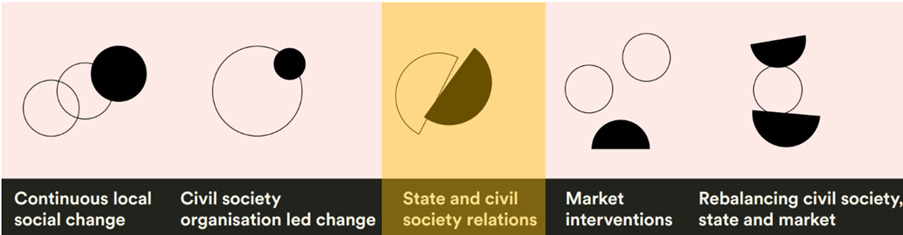
(Source: Place and Evidence, 2026)
If we want to shift the conditions holding poverty and inequality in place, then we need to understand the problems in front of us and the structural issues driving them. Diagnosis then is not a luxury or clever skillset, but rather a vital part of our work in and alongside communities and people facing need. If we want to see and coordinate an impact then we need to co-construct conditions where both children and adults can have enough cognitive space to think, be curious and learn.
Attention is not simply about concentration or being sharply focused; it is about care and curiosity. It might be the difference between what we choose to notice, what we are too busy to see and what becomes possible when we create the conditions to think and understand better. In work and communities shaped by poverty and inequality, what we notice can change what we do next and what might be possible today and tomorrow.
If I still have your attention, then thank you :)
There are a bunch of writers and thinkers below worthy of it too
References and further reading
Blair, C. and Raver, C.C. (2016) ‘Poverty, stress, and brain development: New directions for prevention and intervention’, Academic Pediatrics, 16(3 Suppl), pp. S30–S36.
Evans, G.W. and Schamberg, M.A. (2009) ‘Childhood poverty, chronic stress, and adult working memory’, Proceedings of the National Academy of Sciences, 106(13)
Hanson, J.L., Nacewicz, B.M., Sutterer, M.J., Cayo, A.A., Schaefer, S.M., Rudolph, K.D., Shirtcliff, E.A., Pollak, S.D. and Davidson, R.J. (2015) ‘Behavioral problems after early life stress: Contributions of the hippocampus and amygdala’, Biological Psychiatry, 77(4), pp. 314–323. doi: 10.1016/j.biopsych.2014.04.020.
Harris, S. (2026) ‘Tackling Poverty and Disadvantage in Schools’, Bloomsbury Education.
Hitchin, J. (2026) ‘Institutions changing how they think about place’, Place & Evidence, 3 June. Available at: Place & Evidence Substack
Lupien, S.J., McEwen, B.S., Gunnar, M.R. and Heim, C. (2009) ‘Effects of stress throughout the lifespan on the brain, behaviour and cognition’, Nature Reviews Neuroscience, 10(6), pp. 434–445
Mani, A., Mullainathan, S., Shafir, E. and Zhao, J. (2013) ‘Poverty impedes cognitive function’, Science, 341(6149), pp. 976–980. doi: 10.1126/science.1238041.
Mayer, R.E. (2009) Multimedia Learning. 2nd edn. Cambridge: Cambridge Uni Press.
Newport, C. (2016) Deep Work: Rules for Focused Success in a Distracted World. Piatkus.
Raizada, R.D.S., Richards, T.L., Meltzoff, A. and Kuhl, P.K. (2008) ‘Socioeconomic status predicts hemispheric specialisation of the left inferior frontal gyrus in young children’, NeuroImage, 40(3), pp. 1392–1401. doi: 10.1016/j.neuroimage.2008.01.021.
Roediger, H.L. and Karpicke, J.D. (2006) ‘Test-enhanced learning: Taking memory tests improves long-term retention’, Psychological Science, 17(3), pp. 249–255
Shah, A.K., Mullainathan, S. and Shafir, E. (2012) ‘Some consequences of having too little’, Science, 338(6107), pp. 682–685
Simons, D.J. and Chabris, C.F. (1999) ‘Gorillas in our midst: Sustained inattentional blindness for dynamic events’, Perception, 28(9), pp. 1059–1074. doi: 10.1068/p281059.
Sweller, J. (1988) ‘Cognitive load during problem solving: Effects on learning’, Cognitive Science, 12(2), pp. 257–285