

Adoption stories
Kittens, kids and classrooms


Over the summer period our family grew by two.
Introducing Coco and Crumble. Not children, but kittens. And very cute ones.
Within days of bringing them home, it was obvious that despite being sisters, they are entirely different personalities. One is adventurous and playful, the other cautious and hesitant, retreating to quiet corners until she feels safe. Both are adjusting, both are learning to adapt, but in different ways.
Disclaimer! I do not want to trivialise adoption by comparing it with pets. But the kittens reminded me of a truth that it is easy to forget, especially in schools. Adoption is never a one-size fits all narrative. I say this not merely as an adoptive dad to furry babies but as a dad that has adopted a child too. Nor do I want to state that every adopted or fostered child will inevitably hit all of the barriers explored in this blog.
Every adopted child carries their personal story, shaped by their past and unfolding in their present. To understand and support adoption narratives in schools and other settings, we need to resist a temptation to generalise or assume, and instead begin with the child in front of us. I often state the same about working with children and young people from low income backgrounds too. Assessment, not assumption.
Barriers.
Research consistently shows that adopted children are more likely to face barriers in education.
A study by Brown and White (2017) found that adopted children and young people are around twenty times more likely to be permanently excluded from school. Adoption UK’s Barometer reports shows that exclusion and suspension rates often remain persistently high, with many young people feeling anxious, misunderstood, or stigmatised by their peers. More than half of adopted children say they do not receive the additional support they need in school, even though three-quarters say they need more than their peers (Brooks, 2022).
Behind the statistics can lie deeper challenges.
Difficulties forming trust or attachment (Beckett et al, 2011).
Challenges with executive functioning; memory, planning, attention (Teicher & Samson, 2016).
Higher likelihood of speech or language difficulties (McCrory et al, 2011).
Struggles with change and developing a sense of place (Brown & Shelton, 2023).
Exposure to developmental disorders, including foetal alcohol spectrum disorder (Catterick & Curran, 2014).
The complexity of adoption doesn’t rest only in legal processes or policy frameworks, but in the lived realities of how past experiences shape present learning.
Behind these facts are children who may have experienced neglect, turbulence, or trauma. Beckett et al. (2011) highlight the difficulties some adopted children face with attachment and trust. Teicher and Samson (2016) point to executive functioning challenges, which can affect memory, planning, and concentration.
This is not to say that adoption stories are only stories of difficulty.
National Adoption Week brings together adopted people from baby boomers to Gen Z to share their experiences through the charity Adoption Matters. Many speak powerfully about how adoption has given them stability, belonging, and love. These voices remind us that adoption is not a deficit label; it is part of a young person’s identity, one that schools must hold with care, nuance, and respect.
Belonging.

For me, the starting point has been understanding attachment theory in practice. Considering the value of this in classrooms and school corridors.
Like many educators, I thought I understood it from training and reading. Becoming an adoptive parent taught me otherwise. The reality is far more complex, but also far more hopeful. Attachment-informed approaches are not simply about behaviour management; they reshape how we think about relationships, routines, and trust.
Cognitive science offers another important lens.
Trauma and disadvantage can have neurological impacts that ripple into learning. Well-sequenced teaching, low-stakes retrieval practice, and patient scaffolding are not just good pedagogy; they are essential for children whose executive functioning may be compromised. At Tees Valley Education, where I work, we embed trauma-informed principles into professional development, curriculum planning, and classroom practice. This doesn’t ‘fix’ everything, but it often equips teachers and support staff with tools to respond more effectively, especially in complex situations.
Equally crucial is fostering belonging.
Adopted children are often negotiating complex questions of identity: who they are, where they belong, and how others see them. Schools can play a pivotal role in affirming that sense of belonging. It might be as simple as thoughtful language choices, avoiding careless phrases like “real parents” or as systemic as ensuring adopted children see themselves represented in curriculum narratives. Sometimes even simply adding the word ‘carer’ after parent can make a difference too.
Extra-curricular opportunities also matter: not just as enrichment, but as spaces where children discover new strengths and identities outside the classroom. It is important that the cost of these is carefully considered too.
Behaviour.

I need to mention the ‘b’ word for a moment.
Too often, I hear prominent voices in education dismiss trauma-informed practice or restorative approaches as if they were soft options. The argument usually goes something like this: schools need firm boundaries, strict rules, and high expectation. Anything less risks lowering standards.
I agree with the principle.
Boundaries matter. Expectations matter. Every child deserves adults who believe in them and refuse to accept less than their best. But there is a danger in how this principle is translated into practice. Increasingly, it takes the form of zero-tolerance behaviour policies and rigid, one-size-fits-all rules that strip away context and nuance.
When this happens, schools and other professionals can stop seeing the child. We sanction the pupil whose uniform is wrong without pausing to ask whether home could afford the right one. We punish the pupil who fails to bring in the correct equipment, when the real problem is that the family is already struggling to cover basic costs. We label as ‘defiant’ the teenager who cannot concentrate, when in fact they are carrying the invisible weight of trauma, displacement, or the complex realities of adoption. Zero tolerance can sometimes sit with low level empathy.
I am not advocating for educators to lower expectations or abandon standards.
I am advocating for empathy and understanding as the foundation of those expectations. High standards and compassion are not opposites, they are partners. A school culture built only on punishment risks silencing the very children (and potentially families) who most need to be heard. A school culture built on empathy recognises that behaviour is a form of communication, that hardship shapes how children show up in classrooms, and that punitive measures do not always resolve the underlying issues. Part of education is developing character and shaping behaviour.
This is why trauma-informed and restorative approaches can matter. They are not about excusing behaviour. They are about understanding its roots, responding with dignity, and helping children to re-engage with learning. They offer schools a way to uphold boundaries without dehumanising the child. I do not subscribe to every form of behaviour being some form of communication of distress either. Children and young people, like adults, will often simply get it wrong.
For some, this may feel uncomfortable. A shift away from simplicity towards complexity. But education has always been complex. Children are complex. Adoption is complex.
If school policies cannot work with that complexity, then it is the most vulnerable who will pay the price.
Bale and bonds.
Partnership with adoptive families cannot be overstated. The end of statutory review processes after an adoption order should not mean the end of regular dialogue. This applies to families that foster too.
The most effective schools I have worked with keep open channels of communication and not just when difficulties arise, but to celebrate milestones, anticipate transitions, and co-create solutions. Trust between schools and family helps children and families to thrive. I say this passionately as an adoptive parent!
There is a poignant real-world example that illustrates the power of building environments where families and young people can form bonds. Actor Christian Bale’s charity, Together California, has created a pioneering village in Palmdale, California, designed to keep siblings in foster care together, under the care of trained foster parents, and supported by a 7,000 sq ft community centre and gardens. The project, includes twelve homes and transition studios. The aim is to ensure that children and young people can thrive and that foster siblings are kept together.
“Imagine the absolute pain and the trauma of losing your parents or being torn from your parents, and then losing your brothers and sisters on top of that. That is just no way to treat kids.”
Christian Bale: Actor
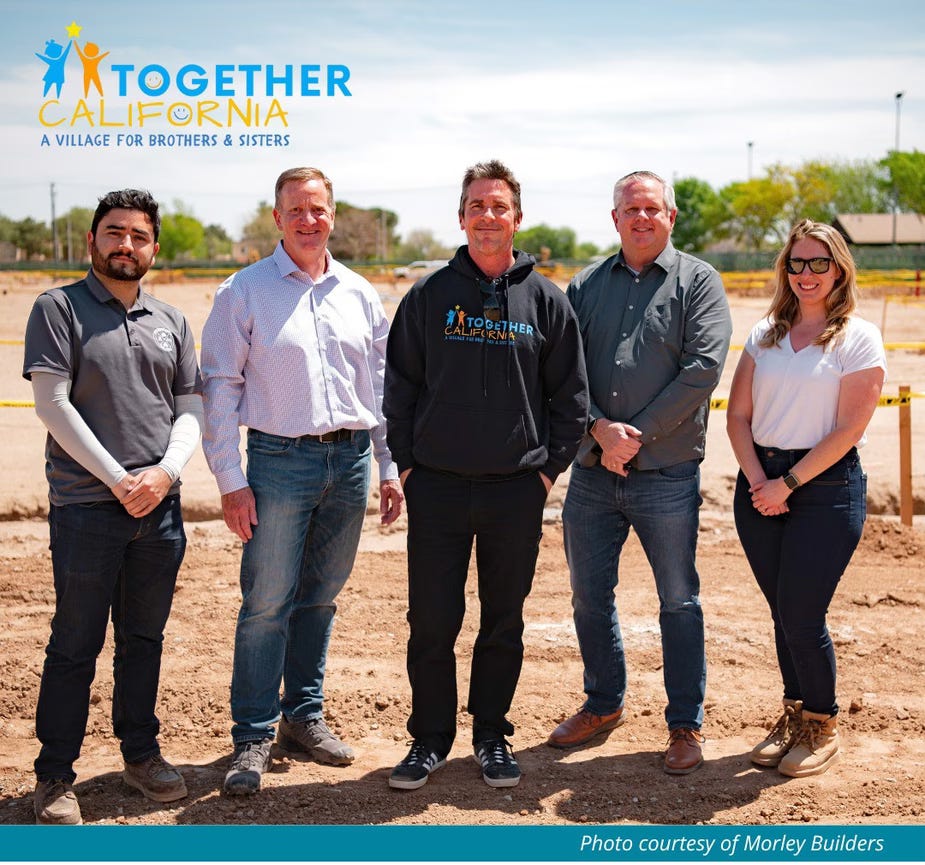
(Source: Instagram/Together California; Morley Builders)
It shows how belonging is not about administrative convenience but about preserving the bonds that matter most. If you want a positive start to your day, watch this short video about it and share it with colleagues.
I firmly believe schools and other settings are ecosystems where bonds are forged. If children and young people exist there, then bonds can be built or broken there.
The average child spends around 15,000 hours at school across their lifetime. For adopted and fostered children, many of whom have already navigated uncertainty and disruption, these hours are vital. They are opportunities for bonds, for growth, and for belonging.
If we see adoption or fostering as a single story, we risk missing the child.
If we commit to knowing them, listening to them, and walking alongside them, schools can become places not just of learning, but of hope and belonging.
I’ve written more on this topic here in SecEd and provided some practical examples to support school leaders and educators. Thanks to SecEd for covering this important topic.
Further research & links.
Beckett et al: Belonging and permanence: Outcomes in long-term foster care and adoption, the British Journal of Social Work (41,4), 2011.
Brooks: From both sides: Evaluating education support for previously looked after children in England, Adoption UK, 2022:
Brown & Shelton: Coherent lives: Making sense of adoptees’ experiences in education through narrative identity, British Educational Research Journal, 2023:
Brown & White: Adoption UK’s Schools & exclusions report, 2017:
Catterick & Curran: Understanding fetal alcohol spectrum disorder: A guide to FASD for parents, carers and professionals, JKP Essentials, 2014.
Coram-I: Adoption and special guardianship leadership data collection: Headline measures, 2023:
DfE: Children looked after in England including adoptions, 2023:
Harris: Poverty on the brain: Five strategies to counter the impact of disadvantage in the classroom, SecEd, 2022:
Harris: Supporting adopted children in school: SecEd, 2024.
Keating: Chosen children? The legalisation of adoption in England and its aftermath, 1918-1939, University of Sussex, 2005.
McCrory, De Brito & Viding: The impact of childhood maltreatment: A review of neurobiological & genetic factors, Frontiers in Psychiatry (2,48), 2011.
Teicher & Samson: Enduring neurobiological effects of childhood abuse and neglect, Journal of Child Psychology & Psychiatry (57,3), 2016.
As ever a fascinating article Sean. Thank you for sharing both your personal and professional knowledge.